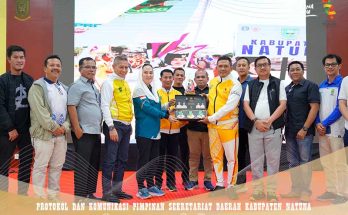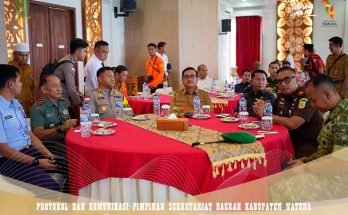
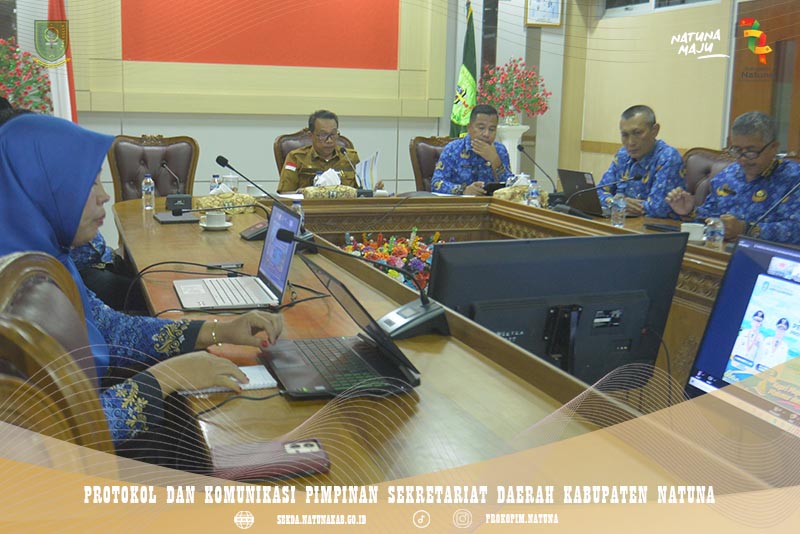
Natuna Deputy Regent Jarmin joined the 2026 Poverty Reduction Program Evaluation Meeting of the Riau Islands Province online from the second floor of the Natuna Regent’s Office, Batu Sisir Bukit Arai Street, East Bunguran District, on Tuesday morning (November 17). He was accompanied by the Head of the Natuna Regional Development Planning, Research, and Innovation Agency (Bapperida) and several heads of related regional government offices.
The meeting was led by Riau Islands Deputy Governor Nyanyang Haris Pratamura and attended by regents, mayors, heads of regional government offices, TP PKK representatives, central government agencies, and the National Zakat Agency (Baznas) of the Riau Islands Province.
In his speech, Nyanyang said that based on Statistics Indonesia (BPS) data, the poverty rate in the Riau Islands Province in March 2026 was 4.09 percent. This was the fourth-lowest poverty rate in Indonesia and the lowest in Sumatra, remaining within the province’s target for 2026.
He appreciated the efforts of all district and city governments but reminded them to continue working to reduce poverty. He highlighted three main challenges: the gap between poverty rates in urban and rural and island areas, extreme poverty, and data quality and social protection.
The poverty rate in rural and island areas was almost twice as high as in urban areas. Meanwhile, an estimated 3,293 households were living in extreme poverty, with the highest number in Batam City. Data matching as of October 20, 2026, also showed 784 active households, 71 percent of which were in Decile 1.
Data quality remained another challenge. A total of 113,903 families had not yet been ranked in the National Single Social and Economic Data (DTSEN), while the number of families with inactive status had more than doubled since November 2025. In addition, 26,621 participants of the Health Insurance Contribution Assistance program (PBI JK) were at risk of losing their active status.
Nyanyang stressed that data and administrative issues must not cause poor families to lose access to social protection and health services.
He also noted that some poverty reduction programs had not been carried out well. Food assistance and electricity installation programs for poor households had only been implemented in Lingga Regency. With around six weeks remaining in the budget year, he called for faster program implementation.
As Chairperson of the Riau Islands Province Poverty Reduction Coordination Team (TKPK), Nyanyang gave five main instructions to district and city governments:
1. *Update social data:* Complete DTSEN verification and validation by name and address, giving priority to families without data rankings, especially in Batam City and Tanjungpinang.
2. *Adjust programs to local needs:* Use district priority maps to guide programs. Island areas should focus on transportation and basic services, while urban areas should focus on job creation and areas with high poverty rates.
3. *Speed up program implementation:* Complete social assistance, house repairs, and electricity installation for poor families before the end of the budget year. Related offices were asked to take immediate action.
4. *Protect access to health insurance:* Coordinate with BPJS Health to transfer 2,260 participants to a health insurance scheme funded by the regional government, ensuring that they continue to receive health services.
5. *Complete required documents:* Based on a Ministry of Home Affairs letter dated November 4, 2026, several documents were still missing, including the TKPK Decree of Bintan Regency, Semester I OPPKPKE reports from Anambas Islands Regency and Karimun Regency, and the 2026 RPKD and RAT documents for Karimun Regency. The related governments were asked to complete these documents for proper reporting and accountability.
Nyanyang said that the province aims to reduce poverty to below 4 percent and end extreme poverty by 2029. He stressed that development is not only about numbers, but also about improving the lives of people who need support.
Through this meeting, district and city governments are expected to strengthen cooperation, improve program implementation, and ensure that assistance reaches the people who need it most. (Pro_kopimnatuna/Sr)