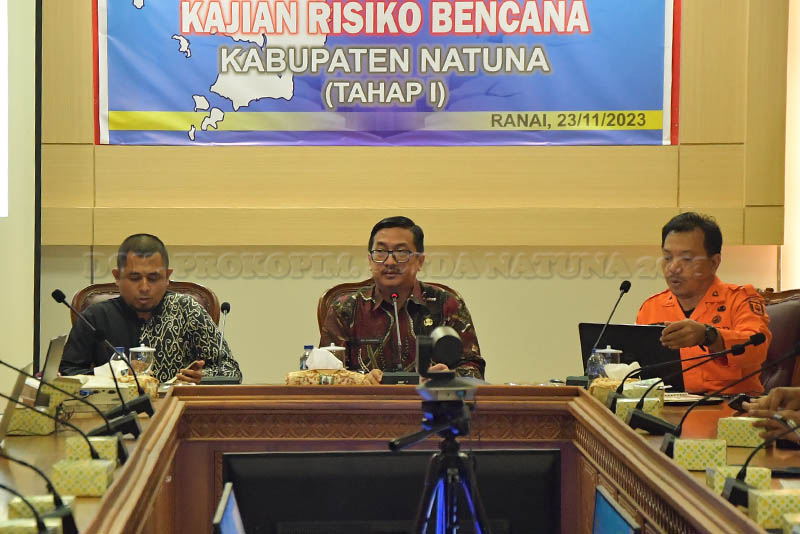
The Regional Secretary of Natuna Regency, Boy Wijanarko Varianto, opened the first phase of the Natuna Regency Disaster Risk Assessment (KRB) Public Discussion, held in the Meeting Room of the Natuna Regent's Office, Batu Sisir Bukit Arai Street, Ranai, Thursday (23/11) morning.
Attended the event were members of the Regional Leadership Coordination Forum, heads or representatives of Regional Apparatus Organisations either in person or online.
In his speech, Boy Wijanarko said that the KRB document is very important, mainly to study, respond to, and detect early indications of disaster.
In the future, it is hoped that the document will not only be available to sub-districts on Bunguran Besar Island, but all sub-districts on separate islands.
This will be very important to do, considering that the KRB document and disaster alert potential are also some of the requirements for fulfilling the Geopark status that Natuna Regency currently has.
To the sources and related organizers, Boy expressed his appreciation and gratitude. With a comprehensive study related to disaster management in the region, he hopes that various events in the disaster category can be handled more quickly, coordinated and condition recovery can also be carried out more quickly.
One of the speakers from the Faculty of Geology, Padjadjaran University Bandung, Nour Chaidir, explained some of the objectives of the activity, including the introduction of indications of disaster occurrence related to geographical and geological forms.
According to him, this will be very useful for field handling and coordination to deal with all possibilities that occur, minimizing casualties, and so on.
According to Nour Chaidir, seen from the geographical aspect, Natuna Regency tends to be faced with several types of disasters, including floods, flash floods, extreme waves, landslides, extreme weather abrasion, tornadoes, and land and forest fires.
To prevent the possibility of the above disasters, he strongly recommends several preventive activities, including planting abrasion-prevention trees, revamping sewerage and reforestation. (Pro_kopim/Endang)
RILIS PERS, Number : 0249 /PRO_KOPIM/2023
Related Posts