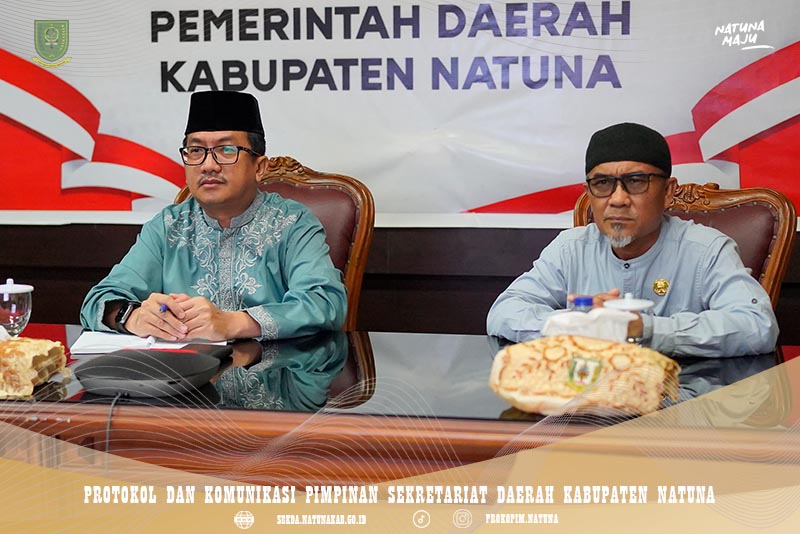
Natuna Regional Secretary Boy Wijanarko Varianto attended a virtual coordination meeting on land provision for the Merah Putih Village and Urban Village Cooperatives (Koperasi Desa/Kelurahan Merah Putih – KDKMP). The meeting was held via Zoom from the second-floor meeting room of the Natuna Regent’s Office on Batu Sisir Road, Bukit Arai, Bunguran Timur District, on Friday morning (July 31).
The meeting was also attended by heads of relevant Regional Government Agencies (OPDs), the Secretary of the Directorate General of Village Government Development, several directors under the Directorate General, the Director of Education and Training of the Indonesian Army Territorial Center, the Director of Territorial Capability Development of the Army Territorial Staff, as well as provincial and regency/city regional secretaries from across Indonesia.
During the meeting, Dr. Bahri, representing the Directorate General of Village Government Development, explained that the government is accelerating the construction of KDKMP retail outlets, warehouses, and supporting facilities. To support this effort, several implementation mechanisms and legal frameworks governing special government appointments must be taken into consideration.
One of the legal foundations highlighted was Law No. 16 of 2025, the Fourth Amendment to Law No. 19 of 2003 on State-Owned Enterprises.
Bahri also outlined follow-up measures to address challenges in the development of KDKMP facilities. He emphasized that villages without available land should receive equal treatment by utilizing a loan-for-use (pinjam pakai) scheme to access land for development.
He further stressed that no new KDKMP facilities should be built on land designated under spatial planning as Sustainable Food Agricultural Land (LP2B) or Protected Rice Fields (LSD). For cooperatives that have already been established on such land, he said, the government needs to formulate affirmative policies to address their status.
To support the program, Bahri explained that regional governments have been tasked with preparing suitable land sourced from village assets or provincial, regency, and municipal government assets that meet the required criteria.
Regional governments are also expected to integrate the KDKMP program into their regional development planning documents and annual budget (APBD), while providing both licensing and non-licensing support to accelerate the construction of retail outlets, warehouses, and other supporting facilities.
In addition, local governments are required to establish verification and validation teams in accordance with Minister of Cooperatives Regulation No. 1 of 2026, which provides technical guidelines for verifying and validating the physical development of KDKMP facilities, including the necessary budgetary support.
In his closing remarks, Bahri encouraged regional governments to strengthen funding collaboration among provincial, regency, municipal, and village governments for land acquisition and site preparation. Such cooperation, he noted, is essential to ensuring the successful implementation of the KDKMP program, which has been designated as one of the government’s national priority programs.(Pro_kopimnatuna/S)
RILIS PERS, Number : 0674/PRO_KOPIM/2025