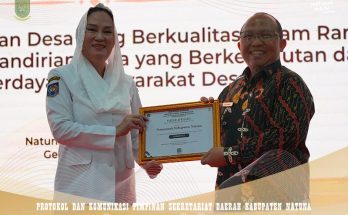
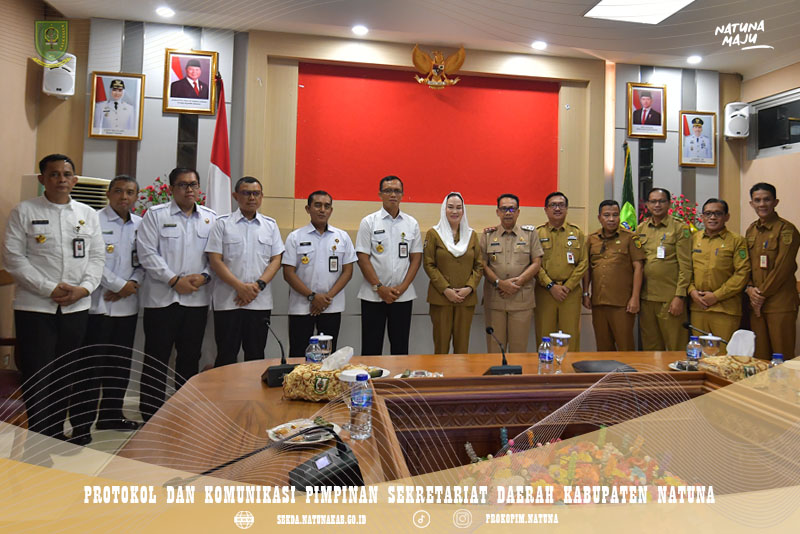
The Natuna Regency Government welcomed an official delegation from Indonesia’s National Defense Council (DPN RI) on Tuesday (July 14). The visit included a strategic discussion held at the Regent’s Office in Bukit Arai, East Bunguran District, focusing on regional development and border area issues.
Leading the delegation, Major General TNI Suarno expressed his appreciation for the warm reception and the constructive dialogue with the Natuna Regency Government. He explained that the National Defense Council serves as an advisory body to the President, providing strategic recommendations on matters related to national sovereignty, territorial integrity, and national security.
Suarno noted that while the Council’s primary focus is on defense and security affairs, discussions may also cover broader issues affecting border regions, including economic development and regional resilience.
During the meeting, Natuna Regent Cen Sui Lan welcomed the visit as an important opportunity to present the realities and challenges faced by one of Indonesia’s outermost border regions.
She explained that 99 percent of Natuna’s territory consists of sea, with a population of around 85,000 residents spread across 17 districts and numerous islands. These geographical conditions create unique challenges in delivering public services and accelerating regional development.
The Regent emphasized that Natuna possesses enormous natural potential, yet many of its development efforts remain constrained by limited local authority and structural challenges.
One of the key concerns she raised was the limited authority of regional governments to manage marine resources. Despite Natuna’s vast waters and abundant fisheries, current regional autonomy regulations place marine resource management under the authority of the central government. As a result, the local administration has limited capacity to maximize the economic potential of its own maritime territory.
She also highlighted the ongoing challenges faced by local fishermen operating in the North Natuna Sea, where encounters with foreign fishing vessels continue to pose risks and create uncertainty.
According to Cen Sui Lan, Natuna’s strategic location and rich marine resources should make fisheries, maritime industries, and marine tourism major drivers of the local economy. However, these opportunities have yet to be fully realized.
The Regent added that agricultural development also faces significant limitations due to the region’s geographical characteristics. Local food production remains insufficient to meet domestic demand, with much of Natuna’s food supply still relying on shipments from neighboring regions such as Tanjungpinang and West Kalimantan.
On tourism, she explained that Natuna is currently pursuing UNESCO Global Geopark status as part of its efforts to promote its unique natural attractions, including pristine beaches, world-class diving sites, and scenic mountain landscapes. Nevertheless, tourism growth continues to be constrained by the high cost of air transportation, which affects accessibility to the islands.
While acknowledging the central government’s strong commitment to safeguarding Indonesia’s sovereignty in Natuna, Cen Sui Lan stressed that border security should go hand in hand with sustainable economic development. She expressed hope that greater national attention would be directed toward strengthening sectors that can improve livelihoods, create jobs, and enhance the welfare of communities living in Indonesia’s frontier regions.
She concluded by noting that Natuna’s fiscal capacity has become increasingly constrained due to declining revenue-sharing allocations and the impact of nationwide budget efficiency measures, making stronger support from the central government essential for the region’s long-term development. (Pro_kopimnatuna/Endang)
RILIS PERS, Number : 0661/PRO_KOPIM/2025