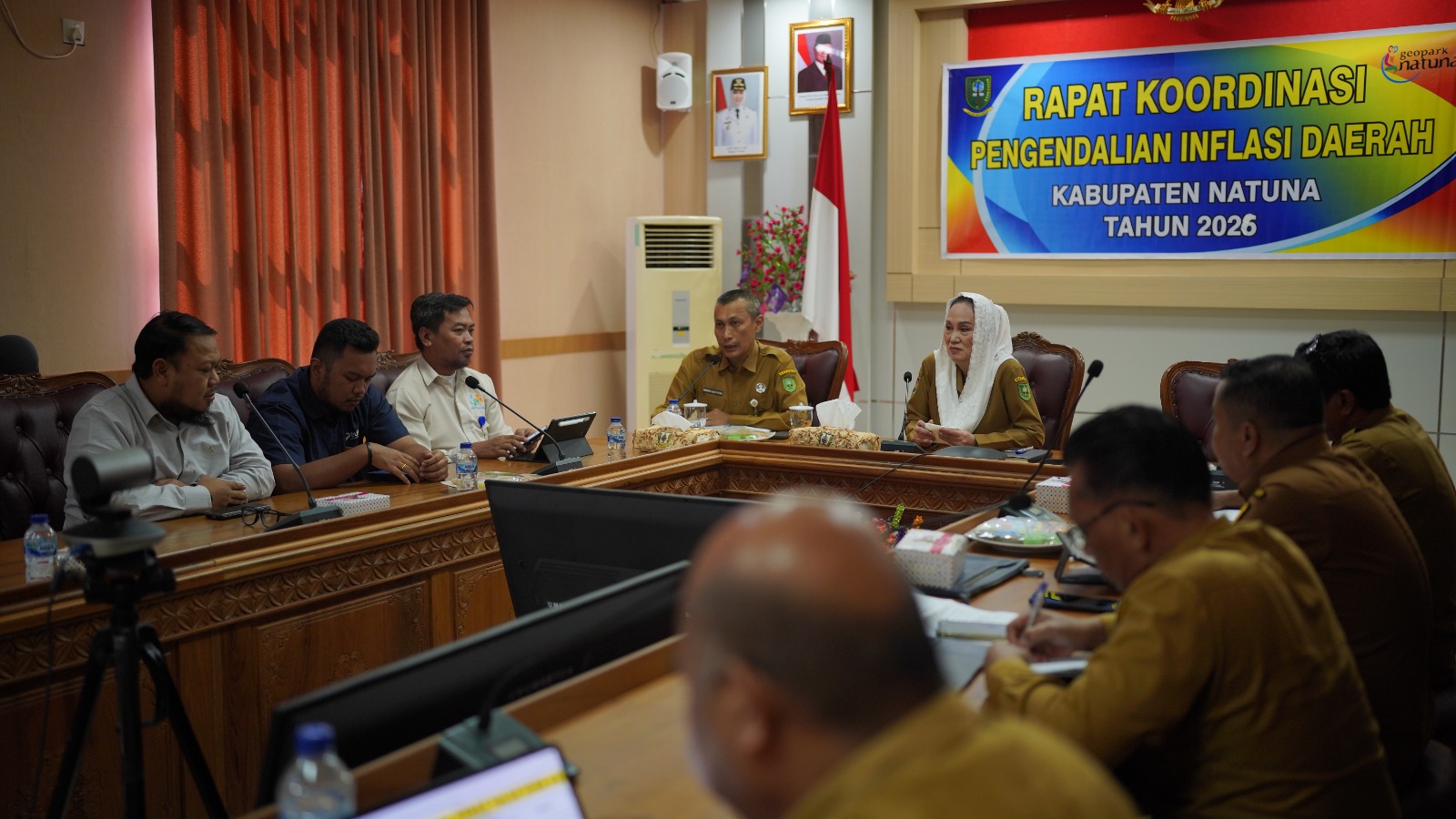
The Regent of Natuna, Cen Sui Lan, accompanied by the Acting Assistant for Economic Affairs and Development of the Natuna Regional Secretariat, chaired the 2026 Coordination Meeting of the Regional Inflation Control Team (TPID). The meeting was held in the meeting room of the Natuna Regent’s Office on Jalan Batu Sisir Bukit Arai, Bunguran Timur District, on Tuesday morning (April 14).
The meeting was attended by several heads of relevant Regional Apparatus Organizations (OPD), sub-district heads across Bunguran Besar, the Head of Bulog Natuna, the Head of Pertamina Depot Natuna, and the Head of BPS Natuna Regency.
The TPID meeting serves as a cross-sector coordination platform to formulate strategies for controlling inflation, while also reflecting the regional government’s commitment to maintaining price stability and ensuring the availability of essential goods for the community.
In her remarks, Cen Sui Lan emphasized that inflation control must be carried out in an integrated manner, involving all stakeholders. A collaborative approach, she noted, is essential to produce policies that are responsive to both local and national economic dynamics.
According to her, the availability of goods must be supported by adequate transportation access, as smooth logistics distribution plays a crucial role in maintaining price stability—particularly in archipelagic regions like Natuna, which face unique geographical challenges.
In addition, the regional government continues to strengthen coordination with Bank Indonesia Representative Office of the Riau Islands Province to ensure the steady supply of essential commodities at stable prices.
This synergy is expected to enhance the effectiveness of inflation control through data-driven policies and continuous monitoring.
Several strategic measures were discussed, including strengthening the distribution system, conducting regular price monitoring, and implementing policy interventions in response to significant price increases.
She expressed hope that these inflation control efforts will help maintain public purchasing power and strengthen sustainable regional economic resilience and stability.
RILIS PERS, Number : 0632/PRO_KOPIM/2025