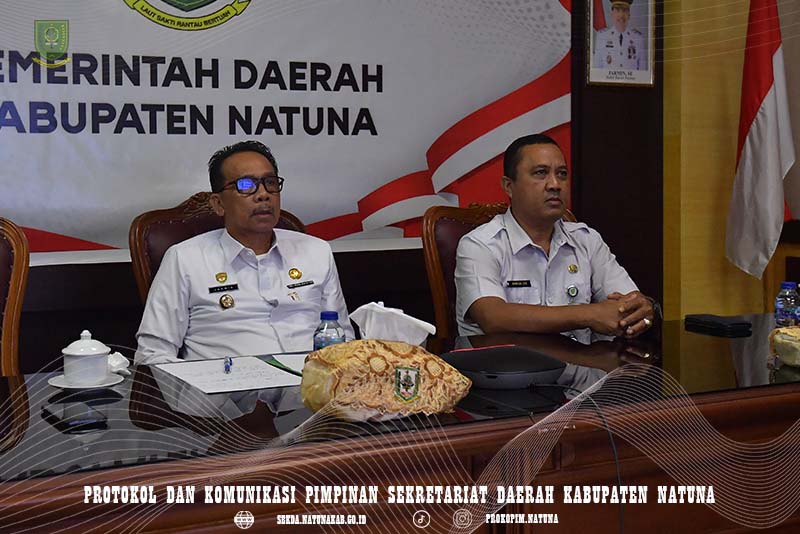
The Deputy Regent of Natuna, Jarmin, S.E., took part virtually in a Working Meeting and Hearing of the Special Committee on National Border Area Management, held on Wednesday (21/01) via Zoom from the second floor meeting room of the Natuna Regent’s Office, Bunguran Timur Subdistrict.
The meeting brought together the Minister of Home Affairs, the Head of the National Border Management Agency (BNPP), the Chair of Commission II of the Indonesian House of Representatives (DPR RI), along with governors, regents, and mayors from across the country.
In his remarks, Commission II DPR RI member Muhammad Rifqi Nizam Karsayuda expressed appreciation to ministries, national institutions, and regional governments for their continued cooperation in managing Indonesia’s border areas.
He shared that he had recently visited several border regions, including West Kalimantan, which shares a land border with Malaysia, as well as parts of the Riau Islands Province. Additional visits to Papua and East Nusa Tenggara are planned in the near future.
According to Rifqi Nizam, these activities reflect the constitutional mandate of Commission II DPR RI, which carries responsibility for legislation, oversight, and budgeting, particularly in relation to national border management.
He also reaffirmed Commission II’s commitment to improving the conditions of border regions by strengthening development across key sectors such as education, healthcare, infrastructure, and public services.
During the same session, Deputy Governor of the Riau Islands Province, Nyanyang Haris Pratamura, presented an overview of the region, noting that the province has a population of 2,271,860 people spread across 228 inhabited islands. Many of these islands are located in strategic border areas adjacent to Singapore, Malaysia, Vietnam, and Cambodia.
He explained that the Riau Islands Province is dominated by maritime territory, with 92 percent consisting of sea area (approximately 25,214 square kilometers), while land accounts for only 8.8 percent. All regencies and cities in the province are classified as border regions, as stipulated in Presidential Decree No. 6 of 2017.
Nyanyang highlighted that several border areas continue to face infrastructure challenges, particularly in transportation. These limitations contribute to high development costs, restricted movement of people and goods, limited food supplies, and constraints on trade and industrial growth.
In response to these conditions, he expressed hope for stronger support from the central government, especially the Ministry of Transportation, through the provision of a more effective and sustainable sea toll (Tol Laut) network.
He also conveyed the President’s commitment to improving healthcare services in the province, including better referral systems to Batam, the construction of additional community health centers (Puskesmas), increased operational funding, strengthened medical workforce capacity, improved availability of medicines, and enhancements to healthcare facilities—particularly in border regions. (Pro_kopim/Endang)
RILIS PERS, Number : 0603/PRO_KOPIM/2025