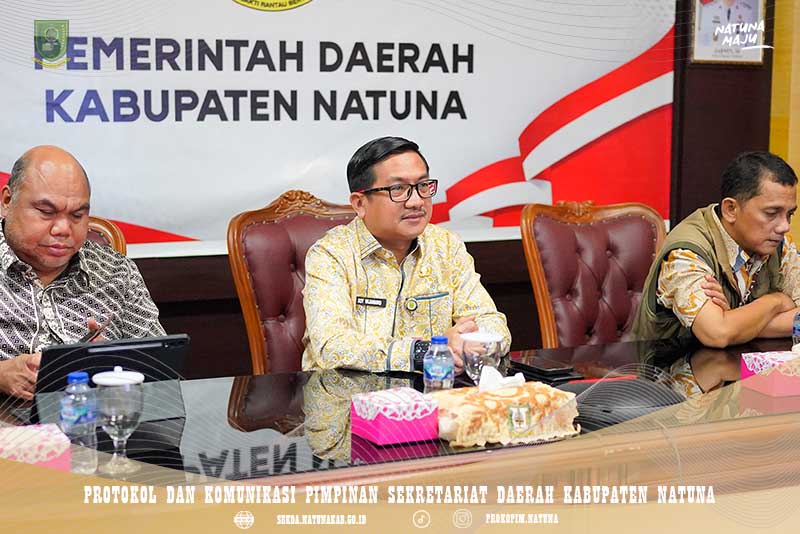
Natuna Regional Secretary Boy Wijanarko Varianto attended an online socialization session held by the Ombudsman of the Republic of Indonesia (Ombudsman RI) on the 2026 Public Service Maladministration Assessment. The event took place via Zoom from the second-floor meeting room of the Natuna Regent’s Office on Batu Sisir Road, Bukit Arai, Bunguran Timur District, on Thursday morning (July 30).
Several heads of relevant regional government agencies (OPDs) also joined the meeting, alongside representatives of Ombudsman offices from across the Riau Islands Province.
The session was officially opened by Riau Islands Provincial Secretary Misni, SKM., M.Si., who expressed appreciation for Ombudsman RI’s consistent commitment to carrying out its mandate of overseeing public service delivery while encouraging the development of governance that is cleaner, more transparent, accountable, and effective.
Misni emphasized that the Ombudsman serves not only as a supervisory institution but also as a strategic partner for regional governments in fostering a public service culture that prioritizes the needs and interests of the community.
He added that the success of government administration should not be measured solely by the scale of physical development, but also by how easily citizens can access services that are fast, fair, and people-centered.
According to Misni, public service represents the face of the state. It is through service counters and public service offices that citizens judge the government’s presence, build their trust in public institutions, and assess the integrity of the bureaucracy.
For that reason, he stressed that there should be no room for any form of administrative malpractice, unnecessarily complicated procedures, procedural uncertainty, or abuse of authority. Every citizen, he said, has the right to receive quality public services as guaranteed by law.
During the same session, Ombudsman RI Commissioner Syafrida R. Rasahan, SH., MH. explained that the assessment is part of the Ombudsman’s annual evaluation program conducted through its provincial representative offices across Indonesia.
The assessment aims to evaluate the quality of public services delivered by government institutions using several key indicators. These include the input, process, output, and complaint-handling dimensions of public service delivery.
In addition, the Ombudsman assesses how well government agencies comply with corrective recommendations issued following previous evaluations, as well as the level of public satisfaction with the services provided.
Syafrida noted that based on assessments conducted in recent years, the Riau Islands Province has consistently achieved a “Good” category for public service quality, although its overall score has yet to reach a higher level. Meanwhile, nearly all regencies and municipalities in the province received evaluation scores within the “Fair” category.
Referring to these results, she encouraged all regional governments to use last year’s assessment as a benchmark for improving service quality across every regional government agency (OPD). She also emphasized the importance of strengthening public service facilities, infrastructure, and the competence of service personnel so that public institutions can truly reflect a government that serves its people with professionalism and excellence.(Pro_kopimnatuna/Endang)
RILIS PERS, Number : 0673/PRO_KOPIM/2025