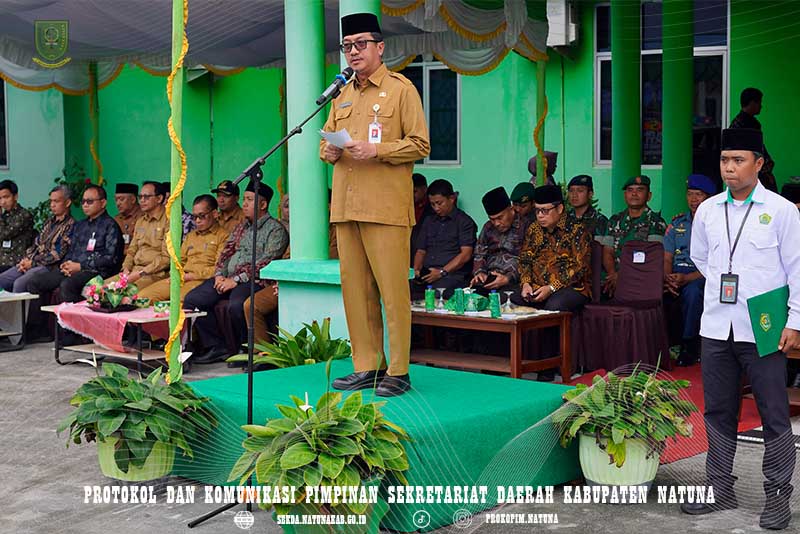
Natuna Regional Secretary Boy Wijanarko Varianto served as Inspector of the Ceremony at the commemoration of the 80th Anniversary of the Ministry of Religious Affairs (Hari Amal Bhakti/HAB) in 2026. The ceremony was held on Saturday morning (03/01) at the Natuna Regency Office of the Ministry of Religious Affairs, HR Soebrantas Street, Bandarsyah, Ranai.
The event was attended by the head and staff of the Natuna Ministry of Religious Affairs Office, members of the Regional Leadership Coordination Forum (Forkopimda), heads of regional government agencies, school principals, and student representatives from institutions under the Ministry’s authority in Natuna.
In his address, Boy Wijanarko highlighted the HAB theme, “Harmonious Communities and Synergy for a Peaceful and Progressive Indonesia.” He explained that harmony is not merely the absence of conflict, but a productive national force—where differences in faith, identity, and social background are woven into collaborative strength to drive national progress.
He noted that eight decades of service reaffirm the Ministry of Religious Affairs’ founding mission as a guardian of religious values within the framework of the nation. That role, he said, has become broader and more vital, encompassing efforts to improve the quality of religious education, nurture interfaith harmony rooted in shared humanity, empower community-based economies, and ensure religion contributes concrete solutions to national challenges.
Boy also underscored the Ministry’s ongoing efforts to strengthen the economic foundations of religious communities through thousands of pesantren and faith-based social economic instruments such as zakat, infaq, waqf, alms, diakonia, church offerings, punia funds, paramita funds, and charitable funds. These initiatives, he said, not only promote institutional independence but also stimulate the wider community economy.
Addressing contemporary challenges, he encouraged reflection on the history of religious civilization as a source of global enlightenment, citing Baitul Hikmah in the medieval era as a leading intellectual center of its time. More than a library, it functioned as a major research and translation hub, where religious values and rational thought combined to advance human civilization.
To uphold this important role, Boy stressed that all Ministry of Religious Affairs civil servants must continue to transform—becoming agile, adaptive to change, open to technology and information, and responsive in delivering services grounded in core values. (Pro_kopim/Endang)
RILIS PERS, Number : 0597/PRO_KOPIM/2025